
8/1/2026 · IVF & Fertility Care in Japan
My AMH is very low. Is ovarian stimulation still worth it?
AMH is a number about your "reserve." It does not predict egg quality, and on its own it does not decide whether you should do a stimulation cycle. What shapes the next step is how it looks next to a few other numbers.
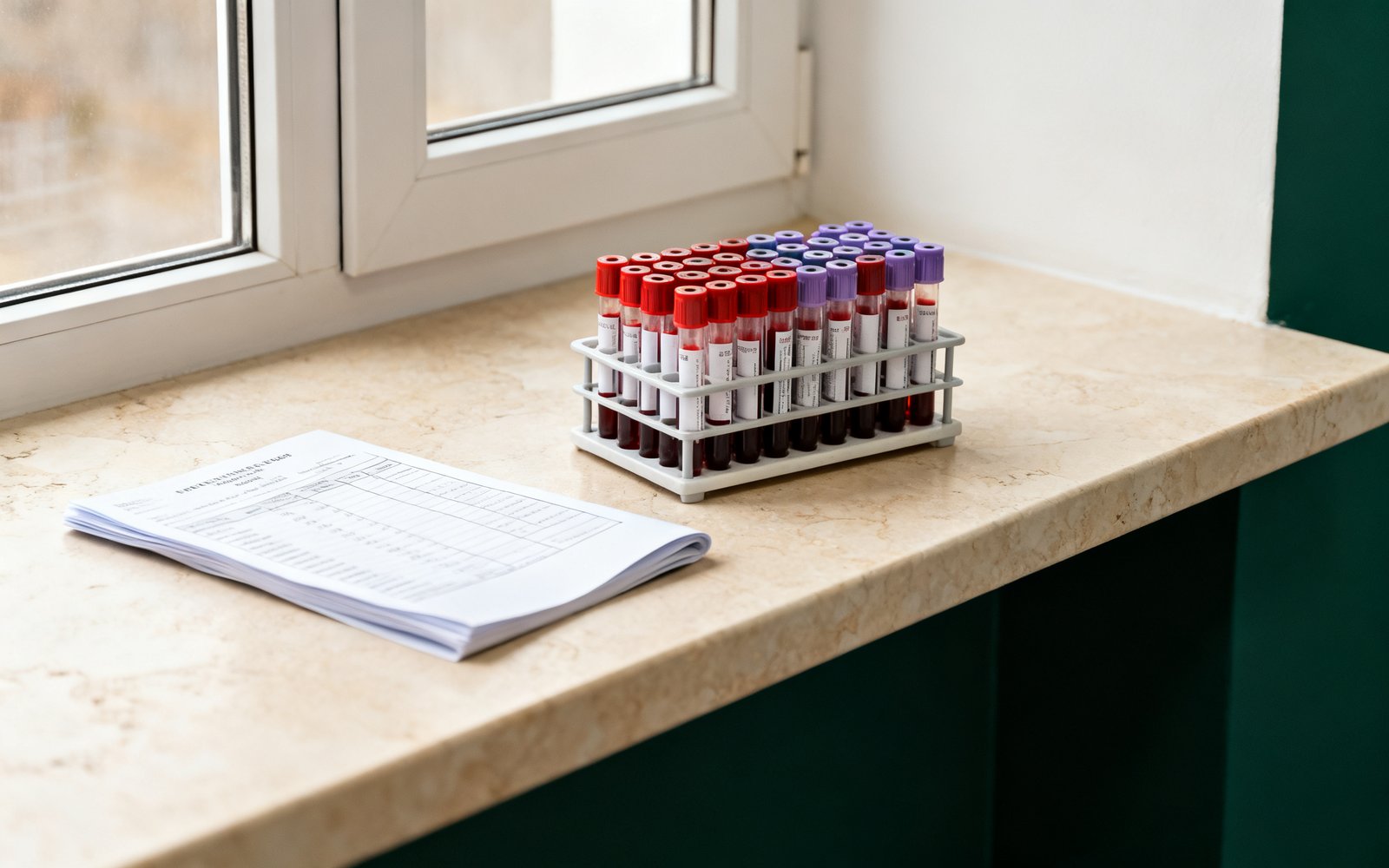
On your report, AMH is followed by a number with two decimal places. The doctor glances at it, says "a bit low," and turns the page. At home you type the number into a search bar and get "premature ovarian failure," "the level of a woman in her forties," and a pile of claims that contradict each other. The more you read, the more anxious you get, until you land on a very practical question: if it is this low, is it still worth the money, the time off work and the injections to do a stimulation cycle?
That question deserves a proper answer. Not a quick "don't lose heart," but a point-by-point look at what this number can tell you and what it cannot.
1. AMH measures quantity, not quality
AMH (anti-Müllerian hormone) is a hormone made by small follicles in the ovary that are at an early stage of development. The level in your blood roughly reflects how many follicles can currently be recruited. In plain terms, it is an estimate of your "reserve."
The key is knowing its limits: it estimates how many are left, not how good the remaining ones are.
This matters because it explains something that confuses many people. Take two women with similar AMH levels, one in her early thirties and one in her early forties. They are actually facing two different problems. For the first, the question is mostly "how many eggs can be retrieved in one cycle." For the second, there is an added question: how the eggs themselves change with age. If you take age out of the picture and look only at AMH, you head in the wrong direction.
2. One number is not enough to decide. Doctors look at a set
In the clinic, AMH is never used on its own. It is usually considered alongside at least the following:
- Antral follicle count (AFC): an ultrasound early in your period that directly counts the small follicles visible in both ovaries. It describes the same thing as AMH from a different angle, one through a blood test and one through imaging.
- Hormone levels on day 2–3 of your cycle: FSH, LH, estradiol and others.
- Your age.
- How you actually responded in previous stimulation cycles: if you have done one before, this often carries more weight than everything above. What actually happened is more reliable than a prediction.
One more thing worth knowing: AMH results are affected by the assay and the laboratory, so two numbers from different facilities cannot always be compared directly. If you have two AMH results from two facilities, first find out which method each one used and what its reference range is, and only then talk about "how much it has dropped." Also, if you are using or have recently stopped hormonal contraception, your AMH may test lower. Tell your doctor when you are tested.
3. Low AMH changes "how many eggs per cycle," not "whether you can do it"
Put the two sections above together and you reach a fairly calm conclusion. The most direct effect of a low AMH is that the expected number of eggs retrieved in a single cycle should be adjusted downward, and there are fewer stimulation protocols to choose from. AMH itself is not an on/off switch for "do it or don't."
What really decides whether to start is usually three other things:
- Your age, and how much more time you can give this.
- The reasonable expectation your doctor gives for this one cycle, based on the full set of results. Note that it is "this one cycle," not "the final outcome."
- Your own judgment of the cost: time, money, time off work, and the physical and emotional toll. How far are you willing to go for one uncertain attempt?
The third has no medical answer. But it is often the question that nobody has actually talked through.
4. Something we need to say up front
Around the words "low AMH" there are many treatments that claim to bring the number back up. Here we have to say something that does not work in our own favor:
At present, there is no widely accepted method that can regrow a follicle reserve that has already declined. Any claim that promises to "rejuvenate the ovaries" or "raise your AMH" should first be treated as a claim that needs to be verified, not as established fact.
This applies to treatments we sell as well. For diminished ovarian function, there is a category of therapies injected into the ovary (autologous platelet-rich plasma, or PRP, mesenchymal stem cells and others), and they are not cheap. In a July 2026 price list we have, intraovarian injection of adipose-derived mesenchymal stem cells costs JPY 3,520,000 (tax included) for a single session, JPY 6,688,000 for a 2-session package, JPY 9,504,000 for 3 sessions and JPY 11,968,000 for 4 sessions. Some facilities offer it as self-pay treatment. The published evidence is still at a fairly early stage: most existing studies are small, there are no large randomized controlled trials showing that it improves live birth rates, and the findings are mixed. The procedure itself also carries risks, such as bleeding and infection from fat harvesting and ovarian puncture.
We offer this service, and we will tell you the paragraph above word for word. A decision made after you understand the limits of the evidence holds up better over time than one made on hope.
5. Next step: gather these three documents today
Before you make any decision, find the following three items, take photos and keep them in one folder:
- Your AMH report: the value, the report date and the testing facility. If the assay method and reference range are printed on it, keep those too.
- Your day 2–3 hormone report: FSH, LH, estradiol and others, again with the date.
- Your most recent antral follicle count: the number of follicles in each ovary on the ultrasound report. If you have never had one, that is the test to add at your next appointment.
Then take them with you and ask your doctor four questions:
- Given my current results, what is a reasonable range for the number of eggs from one stimulation cycle?
- Which protocols suit me, and what are the trade-offs of each?
- If this cycle does not go well, what are my options next?
- Is there any test I am still missing before I start?
If you already have these reports but cannot make sense of them, you can send them to us (with your name, ID number and other identifying details removed). We will first mark what each item means and its date, so you can ask the right questions at your next consultation. We do not diagnose, and we do not draw conclusions on the doctor's behalf. What we can do is make sure you are no longer thrown by a single number with two decimal places.
#low AMH IVF#diminished ovarian reserve#can you increase AMH#IVF
Related service: IVF & Fertility Care in Japan